c0de
Programming in Minecraft, one block at a time.
c0de is a small programming language inside Minecraft. You don't type programs, you build them: every line is a row of colorful blocks on a sheet of endless greenbar paper, in a dimension of its own. Trigger blocks anywhere in your world start the programs. Their results can open doors, move items, play sounds, or ask a web server for the weather.
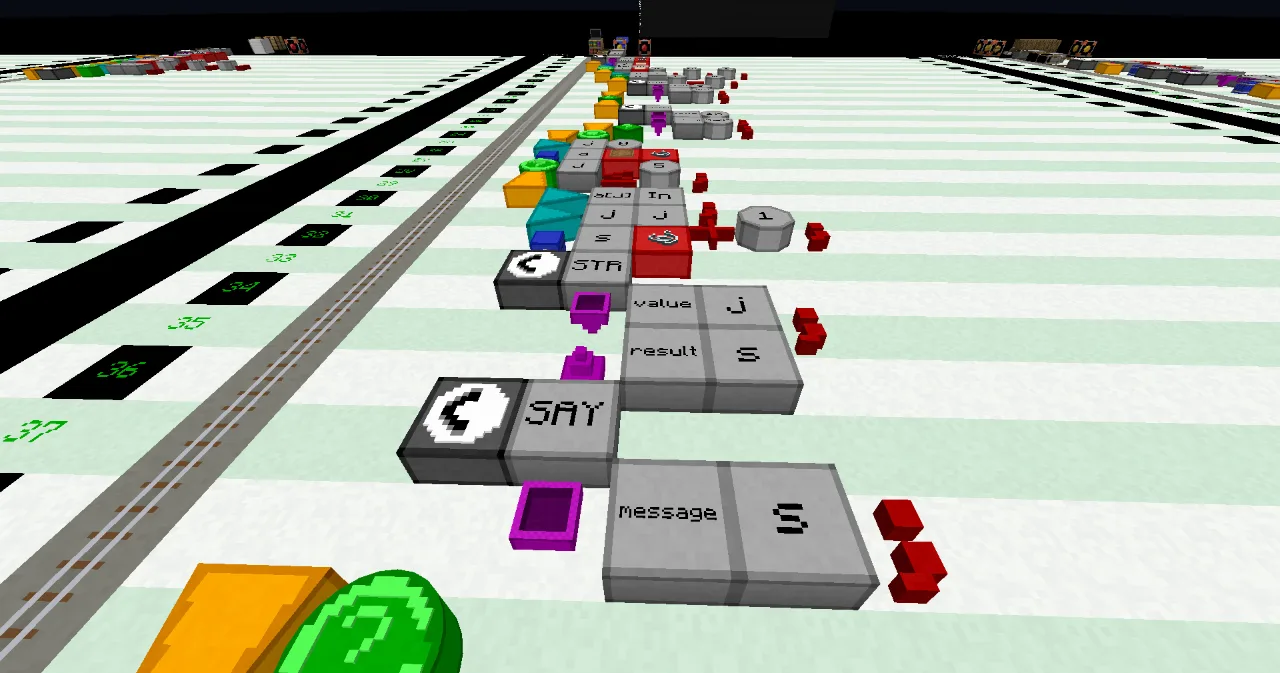
A first program
In the documentation, programs are written as text: one word is one block, one line is one row of blocks, and four spaces mean one block further east.
PROGRAM greeting
NOOP
NOOP
FUNCTION greet
    PARAMETER name STRING "World"
    PARAMETER mark CHAR '!'
    RESULT result STRING
BEGIN
    ASSIGN result "Hello, " ⊕ name ⊕ mark ;
END FUNCTION
The function greet joins three parts into one text. Called with the name "c0de", it returns "Hello, c0de!". The guide shows how to build and run it.
Get c0de
c0de 0.3.0
The programming language made of blocks, with its own dimension, triggers, tools and the libraries c0de/math, c0de/strings, c0de/time and c0de/minecraft.
c0de net 0.1.0
Adds the library c0de_net/http, so programs can send HTTP requests to web servers and REST APIs.
Both mods run on Minecraft 1.21.1, 1.21.11, 26.1.2, 26.2 and 26.3, with Fabric or NeoForge. They are free and open source (BSD 3-Clause License).
In this binder
The tabs at the right edge of the page lead to the chapters: the language c0de with its guide and handbooks, and every library with one page per function. On small screens, the menu at the top of the page has them. The documentation always describes the latest release of each mod.
- c0de12 chapters
- c0de/math16 chapters
- c0de/strings20 chapters
- c0de/time12 chapters
- c0de/minecraft22 chapters
- c0de_net/http12 chapters